

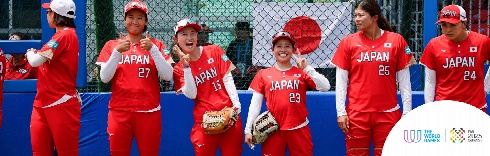
When the Japan Women’s Softball team stepped onto the field at The World Games Chengdu 2025, they carried not only the weight of expectations but also the quiet understanding that this tournament would test them in ways beyond the scoreboard.
In Chengdu, the tournament unfolded at the highest possible level. The United States went on to claim gold in the women’s softball competition at The World Games 2025, with Chinese Taipei (TPE) earning silver, underscoring the depth and intensity of the global field Japan faced on its path to the podium.
The bronze medal they secured on 17 August was hard-earned, forged through rain delays, extra innings, and painful defeats—especially against long-time rivals the United States. Yet, for many players, Chengdu became a defining chapter in their journey toward future gold.
For captain Kyoko Ishikawa, the most unforgettable moment was not one of triumph. “The moment I made a mistake in a lost match,” she recalled. “That error, she explained, became a mirror.”
“When I felt my shortcomings after losing a match, it made clear what I needed to do to prepare for the Olympics.”Ishikawa described the path as uncompromising: “It’s not an easy path. Precisely because it’s such a major tournament, it will profoundly shape my future as both an athlete and a person.”
Several teammates echoed that sentiment, pointing to narrow losses as turning points. Yuuki Kamata, competing in her first official international tournament with the senior national team, still feels the sting of a marathon game against the USA. “Losing the close game with the USA after a long tiebreaker was incredibly frustrating—something I’ll never forget,” she said. Yet there was also reassurance amid the nerves. “When I got a hit in my very first at-bat, I felt relieved. That moment settled me.”
Against elite opponents, adaptability proved to be the team’s greatest challenge. Yume Kiriishi pointed to batting adjustments as the hardest test, while Hotaru Tsukamoto emphasized the difficulty of facing foreign pitchers.
“The semifinal against the U.S., when we lost on a walk-off hit in the 10th inning, is something I still can’t forget,” Tsukamoto said. But she now sees that pain as growth. “I’d describe this journey as ‘Harvest’—because I learned so much, not just from my own team but from the world.”
The road to Chengdu itself was demanding. Limited preparation time and team-building pressures surfaced repeatedly in player reflections. Minori Naito admitted, “The training camp period was short, making team building difficult,” while Natsumi Fujimori described the struggle of finding balance quickly: “Building teamwork in a short timeframe was the hardest part.”
Still, motivation never failed. Many players spoke of responsibility—to the Hinomaru (a reference to the Japanse flag), to fans, and to each other.
Yui Sakamoto said, “Wearing the Hinomaru flag and knowing so many people are cheering us on pushes me harder than usual.” For others, inspiration came from within the squad. Sakura Miwa reflected, “Seeing the backs of veteran players fighting hard made me think about what I should be doing myself.”
The World Games environment itself left a lasting impression. From strict security to shared spaces with athletes from dozens of sports, Chengdu offered something unique. Tsukamoto recalled a small but powerful moment: “I talked with a Japanese weightlifter in the laundry room. Even though our sports were different, we encouraged each other—and that stayed with me.” Kamata added that the Athletes’ Village fostered instant connection. “Even with complete strangers, conversation flowed naturally there.”
Life after Chengdu has subtly but decisively changed. Several players spoke of sharper focus, renewed training intensity, and a clearer understanding of the global standard. “Finishing third completely changed my mindset toward softball,” said Kiriishi. Tsukamoto described concrete changes: reevaluating diet, increasing training volume, and reshaping daily routines to match world-class competition.
Looking ahead, the team sees a sport on the rise. With softball reinstated for the Los Angeles 2028 Olympics, expectations are growing. Kamata believes excitement will only build, while Ishikawa hopes for broader visibility:
“I want it to become a more mainstream sport, popular enough to be featured on TV.”
Asked to sum up the journey in one word, the answers varied—Challenge, Experience, Adventure, Resilience—but the message was unified. As Ayana Karoji put it, “Results only come when you endure and keep building, especially in tough times.”
Bronze in Chengdu may not have been Japan’s main goal, but The World Games 2025 became an important test for the team—building confidence, fueling ambition, and pointing them toward future gold.